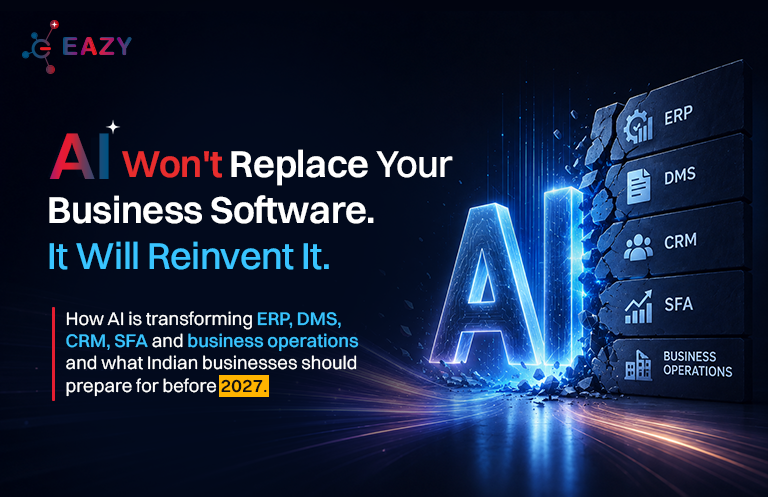
AI in Business Software: What Indian Businesses Should Expect by 2027
“88% of businesses now use AI. Most don’t know what it actually changes inside their ERP, CRM, DMS or SFA. Here’s what Indian businesses should prepare for before 2027.”
Reading Time: 7 Min Read | Published: 05 August 2026
Key Highlights (What you’ll learn)
- How AI is changing software like ERP, CRM, DMS and SFA
- What Indian manufacturers and FMCG brands should prepare for today
- Common myths about AI in business software
- How to choose AI-ready software that grows with your business
Walk into almost any software presentation today and you’ll hear the same thing within the first five minutes.
“Our platform is powered by AI.”
ERP vendors say it, CRM vendors say it, SFA companies say it. Even software that hasn’t meaningfully changed in years suddenly has “AI-powered” printed across its website. Somewhere between the hype and the headlines, AI has become the biggest selling point in business software.
The problem? Very few businesses will be able to recognize and reflect on the meaning and while the world is moving towards AI, the majority of them are still struggling to understand its real use cases. According to McKinsey’s State of AI 2025 report, 88% of organisations today use AI in at least one business function but only about one-third have begun to scale AI across the entire business.
Will AI replace ERP? Will every business need AI? Should you postpone buying software until AI becomes more mature? Or is this simply another technology trend that’s being oversold? These aren’t theoretical questions anymore. They’re discussions happening inside boardrooms, review meetings and vendor evaluations across India.
The question is no longer whether your ERP, CRM, DMS or SFA can record transactions. Increasingly, it’s whether they can help you predict, recommend and make better decisions before opportunities are lost or problems become expensive. This guide cuts through the noise and explains what AI is genuinely changing inside business software, what remains unchanged, and how Indian businesses can prepare for what’s coming next.
Why AI Is Becoming the Next Evolution of Business Software
Definition: AI-powered business software uses ML(machine learning) and connected operational data to move beyond recording transactions, predicting outcomes, recommending actions, and automating decisions in real time across ERP, CRM, DMS, and SFA systems.
Every major shift in business software usually has one objective: to reduce manual effort while improving decision-making. Businesses moved from paper records to spreadsheets, from spreadsheets to ERP, and from disconnected applications to integrated business ecosystems. Artificial Intelligence is the next step in that evolution, not because software has suddenly become intelligent, but because businesses now generate enough connected data for software to do far more than record transactions.
An ERP no longer merely needs to store inventory data; it can identify stock-out risks before they even occur. A CRM can prioritise leads based on buying intent instead of leaving every opportunity to be judged manually. An SFA platform can recommend which retailers deserve prior attention, while a DMS can highlight distributors whose inventory patterns indicate supply issues in the future.
The real shift isn’t that AI is replacing business software. It’s that business software is evolving from recording what happened to helping businesses decide what should happen next. Without connected business data, AI is little more than another chatbot. With connected ERP, CRM, DMS and SFA systems, it becomes a practical decision-support layer that helps businesses operate faster, smarter and with greater confidence.
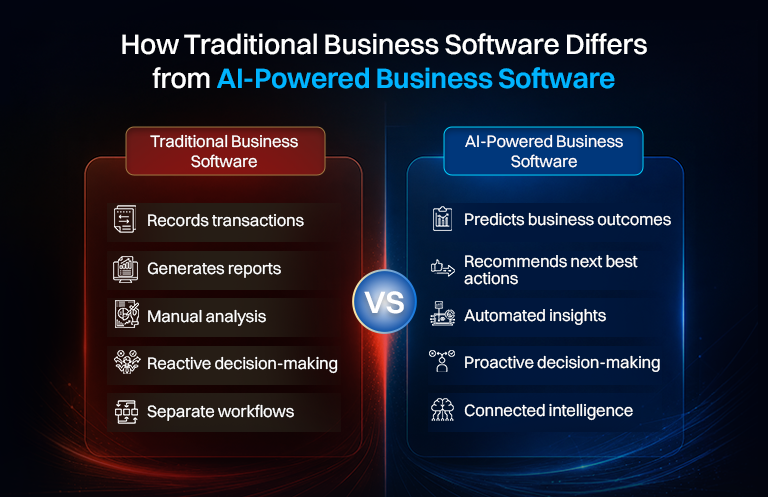
AI doesn’t replace business software, it enhances it by helping businesses predict, recommend and automate decisions rather than simply recording transactions.
What AI Will Change Inside ERP
ERP has always helped businesses record and manage operations. AI will definitely not replace that role, but will make it more proactive. Rather than simply showing inventory levels, financial reports or pending approvals, AI will help businesses anticipate what comes next. Rather than waiting for reports or manually analysing data, ERP systems will increasingly identify risks early, surface opportunities, and recommend actions before they become business problems.
Today, most ERP software helps businesses understand what has already happened, AI-powered ERP will increasingly help businesses understand what is likely to happen next. For example, an AI-enabled ERP could notify you that:
- Inventory for a high-demand SKU may run out within the next five days.
- A customer is likely to delay payment based on historical behaviour.
- Purchase quantities should increase because seasonal demand is approaching.
- Production schedules need adjustment based on distributor demand trends.
- Cash flow may tighten next month unless receivables improve.
If you’re evaluating ERP today, our ERP Implementation Checklist for Indian Businesses explains how to build the right foundation before introducing AI.
What AI Will Change Inside SFA
SFA has traditionally helped businesses monitor field activities, manage beat plans, capture orders, and improve sales visibility. AI won’t change these fundamentals, but will make field sales more intelligent. From merely tracking where sales representatives have been, it will increasingly help businesses identify where they should go, which retailers deserve immediate attention, and what actions are most likely to improve secondary sales. For example, an AI-enabled SFA could recommend:
- Retailers that are most likely to place an order today.
- Outlets at risk of becoming inactive based on buying patterns.
- The most efficient beat plan based on location and retailer priority.
- Products each retailer is most likely to purchase.
- Sales representatives who may need coaching based on execution trends.
With AI, you won’t be just spending time reviewing yesterday’s activities, sales managers can invest more time improving tomorrow’s execution. Eventually, AI won’t replace the field force, it will help every visit become more productive.
Explore our complete guide to Sales Force Automation for FMCG businesses to understand how SFA improves retail execution and field visibility.
What AI Will Change Inside Distribution Management (DMS)
Distribution Management Systems (DMS) have traditionally helped businesses manage secondary sales, distributor inventory, schemes, claims, and retail execution. AI won’t replace these functions, it will make distribution more predictable. Instead of waiting for secondary sales reports or distributor updates, AI will help businesses identify gaps, anticipate disruptions, and recommend corrective actions before they impact market performance. For example, an AI-enabled DMS could identify:
- Distributors likely to face stock-outs in the coming days.
- Retailers at risk of becoming inactive based on buying patterns.
- Trade schemes that are underperforming or driving the highest ROI.
- Territories where secondary sales are slowing despite healthy primary billing.
- Inventory likely to become slow-moving or excess stock.
Instead of reacting to visibility gaps after month-end reviews, businesses will be able to identify distribution risks as they emerge and take corrective action much earlier.
If you’re wondering where a distributor app stops and a DMS begins, read our complete comparison guide.
What AI Will Change Inside CRM
CRM systems have traditionally helped businesses manage leads, customer interactions, sales opportunities, and follow-ups. AI won’t replace relationship management, it will make it more intelligent.From relying on sales teams to manually prioritise customers or identify opportunities, AI has come a long way in analyzing customer behaviour, buying patterns, and engagement history to recommend where attention is needed most. For example, an AI-enabled CRM could identify:
- Leads that are most likely to convert.
- Customers at risk of becoming inactive or switching to competitors.
- The best time to follow up with a prospect.
- Cross-sell and upsell opportunities based on purchase history.
- Sales opportunities that require immediate attention before they are lost.
Instead of spending time deciding who to engage next, sales teams can focus on building stronger customer relationships while AI helps prioritise the opportunities that matter most.
👉 Reading this and wondering, “Can AI actually do this in my business?
That’s a fair question. The answer depends less on AI and more on how connected your current systems and data are. If you’re curious where your business stands, we’re happy to walk you through real-world AI use cases and what’s practical today.
What Are the Biggest AI Myths Businesses Still Believe?
As AI becomes a standard feature across business software, misconceptions are growing just as quickly. Many organisations are delaying technology decisions, chasing unnecessary features, or investing with unrealistic expectations simply because they misunderstand what AI can and cannot do. Here are some of the most common myths business leaders still believe.
Myth 1: AI Will Replace ERP and Business Software
AI doesn’t replace ERP, CRM, SFA or DMS, it depends on them. Artificial Intelligence cannot generate meaningful recommendations without structured business data that you give it priorly. If your operational data is incomplete, inaccurate or scattered across spreadsheets, AI has very little to work with. The quality of AI outcomes will always depend on the quality of the underlying business systems.
Myth 2: Buying AI Software Automatically Makes a Business Smarter
AI is only as effective as the processes behind it. Businesses with poor data quality, inconsistent workflows or low software adoption won’t suddenly become efficient because an AI assistant has been added to their ERP. Technology amplifies operational discipline; it rarely replaces it.
Myth 3: AI Is Only for Large Enterprises
Cloud-based AI has significantly reduced the cost of adoption. Today, mid-sized manufacturers, distributors and FMCG businesses are already using AI for demand forecasting, sales planning, customer engagement and inventory optimization. Competitive advantage is increasingly determined by how effectively businesses use AI, not by their size.
Myth 4: AI Means Fewer Employees
In reality, most AI applications in enterprise software are designed to eliminate repetitive work, not decision-makers. Instead of replacing finance teams, sales managers or operations leaders, AI reduces the time they spend collecting information so they can focus on analysis, planning and execution.
Questions Every Business Should Ask Before Buying AI Software
Every software demonstration today promises intelligent automation, predictive analytics and AI-powered recommendations. The challenge is that not every AI capability delivers meaningful business value. Before investing, businesses should focus less on whether software has AI and more on whether that AI can improve real business decisions.
Ask these questions before evaluating any AI-powered platform:
- Does it use live operational data, or static historical reports?
- Can it explain why it made a recommendation, or is it a black box?
- Can it integrate with our ERP, CRM, DMS and SFA, or will it create another data silo?
- Does it automate repetitive work, or simply generate more dashboards?
- Can it learn and improve as our business grows?
- Will it solve a measurable business problem or simply add another feature?
The best AI platforms don’t succeed because they have the most advanced algorithms, they succeed because they have access to the right business data. AI cannot identify patterns, predict risks or recommend actions if sales, finance, inventory and distribution data remain disconnected. That’s why businesses investing in connected ERP, CRM, DMS and SFA platforms today will be far better positioned to unlock the full value of AI tomorrow.
Final Takeaway
Artificial Intelligence isn’t replacing ERP, CRM, DMS or SFA. It’s making each of them smarter. The businesses that benefit most over the next few years won’t simply be the ones investing in AI, they’ll be the ones building connected systems, clean data, and strong processes today. Because AI is only as powerful as the business data behind it.
At EAZY, we’ve spent over 18 years helping 650+ businesses build connected ERP, DMS, SFA, CRM and HRMS ecosystems that improve visibility, execution, and decision-making. As AI becomes a standard capability, that connected foundation will matter more than ever.
Not sure whether your current ERP, DMS, or SFA setup is AI-ready? We’ll spend 30 minutes reviewing your existing technology stack and tell you honestly what needs to change and what doesn’t.
→ Book a Free AI Readiness Review
We’ll help you understand where AI can create measurable value for your business and how to prepare your technology ecosystem for the years ahead.
Frequently Asked Questions About AI in Business Software
1. Will AI replace ERP systems?
No. AI is not replacing ERP systems; it is making them more intelligent. An ERP system remains the central platform for managing finance, inventory, procurement, manufacturing, and business operations. AI enhances ERP by analysing operational data, predicting risks, recommending actions, automating repetitive tasks, and helping businesses make faster decisions. The future is AI-powered ERP, not AI instead of ERP.
2. How is AI changing business software?
AI is transforming business software from systems that simply record transactions into platforms that can analyse patterns, predict outcomes, and recommend actions. Modern AI-powered ERP, CRM, DMS, and Sales Force Automation (SFA) software can help businesses forecast demand, identify sales opportunities, optimize inventory, improve customer engagement, and automate routine workflows.
3. How can Indian businesses prepare for AI-powered business software?
The most important step is building a connected digital ecosystem. Businesses should ensure their ERP, CRM, DMS, SFA, HRMS, and analytics platforms are integrated and supported by accurate, reliable data. AI delivers the best results when it has access to consistent operational information across departments rather than disconnected spreadsheets and isolated systems.
4. What should businesses look for before buying AI software?
Before investing in AI-powered software, businesses should evaluate whether it:
- Uses live operational data.
- Integrates with existing ERP, CRM, DMS, or SFA systems.
- Explains why it makes recommendations.
- Automates business workflows rather than simply generating reports.
- Solves measurable business problems instead of adding unnecessary features.
The quality of AI depends far more on the quality of business data than on marketing claims.
5. Which business functions will benefit the most from AI by 2027?
AI is expected to create the biggest impact across enterprise operations, including:
- ERP for financial planning, inventory optimisation, and procurement.
- Sales Force Automation (SFA) for retailer prioritisation and beat planning.
- Distribution Management Systems (DMS) for secondary sales visibility and demand forecasting.
- CRM for lead scoring, customer retention, and sales recommendations.
- HRMS for workforce planning and employee analytics.
Rather than replacing employees, AI will help teams make faster and more informed decisions.
6. Is AI in business software ready for Indian SMEs or only large enterprises?
Cloud-based AI has significantly reduced adoption costs. Mid-sized manufacturers, FMCG distributors, and growing businesses are already using AI for demand forecasting, inventory optimisation, and sales planning, not just large enterprises. The barrier today is not cost or company size. It is data quality and connected systems. Businesses with clean, integrated ERP, DMS, and SFA data can unlock AI capabilities regardless of scale.
References:
McKinsey & Company– The state of AI in 2025
Mckinsey & Company– The economic potential of generative AI.
Microsoft – 2025 Work Trend Index
NASSCOM – India’s AI adoption and enterprise technology reports.
IBM – Global AI Adoption Index.
Continue Reading:
