Using Multiple Business Software? Here’s Why It’s Costing You More Than You Think
5 min read > 06 May 2026
Key Highlights (What you’ll learn)
- Why “fully digitized” businesses still struggle internally
- 7 hidden costs of using multiple disconnected systems
- Why AI cannot fix fragmented data foundations
- What changes when systems finally work together
According to Panorama Consulting Group, “A majority of software challenges are linked to poor integration and adoption, not the technology itself.”
A few months ago, we sat down with a well-established household cleaning products manufacturer, strong distribution, growing demand, and by all external measures, a business that seemed firmly in control of its operations. Internally, however, things were layered differently.
They were running separate systems for different functions, an ERP for core operations, a distributor-facing DMS, and a standalone SFA for the sales team. Each platform had been introduced at a different stage of growth, each solving a specific problem at that time, and over the years, this stack had come to be seen not as fragmented, but as “comprehensive.”
In fact, the leadership team was quite clear at the outset: “We’ve already digitized everything. Why change something that’s working?” And they weren’t wrong, at least not immediately.
Orders were being processed, sales teams were reporting activity, distributors were placing orders. Nothing was visibly broken but as we spent more time understanding how decisions were actually being made, a different picture began to emerge. There were moments, subtle, recurring, easy to ignore, where things didn’t quite add up.
No single issue was large enough to trigger an alarm but collectively, they were slowing the business down in ways that weren’t immediately visible on dashboards. What looked like a well-digitized setup was, in reality, a set of systems operating in parallel, not in sync. Let us drill down the 7 hidden costs that we found out in many of our clients and what you can avoid:
Hidden Cost 1. Data Mismatch Becomes a Pattern, Not an Exception
When multiple systems for different purposes capture and process data independently from multiple sources, alignment becomes an exercise rather than a default. This means reports often need reconciliation majorly using manual efforts before they can be trusted.
Hidden Cost 2. Manual Work Continues Despite Multiple Software
Despite being “digitized,” installing multiple softwares for endless uses, teams are still relying on Excel exports, calls, and cross-checks. The reason is not because they are resistant or adamant, it’s simply because implemented systems don’t provide complete clarity on their own.
Hidden Cost 3. Decision-Making Slowing Down at the Top
Employees use workarounds from the system at their own comfort, and reconcile all data in the current system. The collected data is often not the same everywhere and when leadership teams cannot rely on a single, unified view of data, decisions get delayed, not due to lack of intent, but due to lack of confidence.
Hidden Cost 4. End-to-End Visibility Remains a Distant Dream
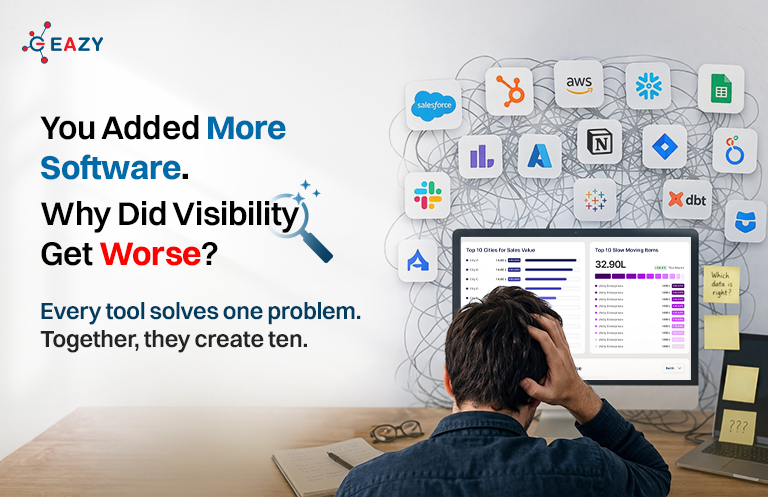
Sales, inventory, production, finance operate within their respective systems, and gathering data from other stakeholders in the supply chain, distributors, retailers, and even influencers seems like it’s out of reach. Without integration of all these data sources, decision makers cannot expect a continuous flow of information across the value chain.
Hidden Cost 5. Higher Costs from Multiple Software Systems
While each tool deployed in the business might be serving purpose and may seem justified individually, but the combined cost that initially seems veiled culminates to a cost that surpasses the figures that were planned. This includes licenses, integrations, and maintenance that often exceeds what a unified system would require.
Hidden Cost 6. Low Adoption of Business Software Tools
While each tool deployed in the business might be serving purpose and may seem justified individually, but the combined cost that initially seems veiled culminates to a cost that surpasses the figures that were planned. This includes licenses, integrations, and maintenance that often exceeds what a unified system would require.
Hidden Cost 7. AI Fails Without Proper Data Integration
With the hype and current push towards AI-led tools, many businesses assume these layers will resolve inefficiencies; however, when underlying systems are fragmented, AI simply processes inconsistent data faster, leading to more confident but not necessarily accurate decisions.
What Changed and Why It Mattered
Multiple business software refers to using separate tools for functions like sales, distribution, and operations without full integration between them. The shift, from multiple to single, wasn’t merely about replacing tools, it was about rethinking how the business should operate as a connected system. By bringing ERP, DMS, and SFA into a unified environment, the organization moved from fragmented visibility to a single, aligned view of operations. Data no longer needed validation across systems, teams no longer depended on parallel tracking, and decision-making became significantly faster because the underlying information was consistent.
Over time, this translated into measurable business impact, including a sustained growth and the client saw a trajectory of over 26% CAGR, driven not by adding more layers, but by removing friction that had quietly built up over the years.
What This Means for Growing Businesses
Most organizations do not struggle because they lack technology, they struggle because their technology evolves in silos. And while each addition feels like progress, the overall system becomes harder to manage, harder to trust, and ultimately, harder to scale.
The question, therefore, is not how many tools you are using but how well they work together. It may be worth asking:
- Do your systems give you one version of truth or multiple versions to reconcile?
- Are your teams relying on the system or working around it?
- Is your data enabling faster decisions or slowing them down?
Because the answers to these questions often reveal more than any dashboard can.
If you’re seeing similar patterns in your business and want to understand what a more connected, scalable setup could look like, it might be useful to explore it in context of your current operations. A focused discussion can often bring clarity not just on tools, but on the approach itself.
→ Book a quick demo with us.
We provide a holistic unified ecosystem from ERP, DMS, SFA, to retail platforms, so that your business doesn’t feel broken and you are able to connect the entire supply chain.
FAQs
Why do software implementations fail even after going live?
Most failures are not due to technology, but due to poor integration with other business software, low adoption, and lack of alignment between systems and workflows.
Is using multiple business software always bad?
Not necessarily but without integration, it leads to data silos, inefficiencies, and higher operational costs. Common issues include data mismatch, lack of visibility, manual work, and delayed decision-making.
Can AI fix disconnected systems?
No. AI relies on existing data. If systems are fragmented, AI amplifies inconsistencies instead of solving them.
What is the best approach for growing businesses?
A unified, integrated ecosystem where ERP, DMS, and SFA work together, ensuring real-time visibility and better decision-making.
Why does data mismatch happen between ERP, DMS, and SFA?
Because these systems operate independently, syncing data at different intervals or formats, leading to inconsistencies unless unified.
References:
International Data Corporation (IDC). (n.d.). The cost of data silos. Retrieved from https://event-web.idc.com/72057/index.html#section_7
Gartner, Inc. (n.d.). Why ERP projects fail. Retrieved from https://www.gartner.com/en/information-technology/topics/enterprise-resource-planning
https://www.gartner.com/en/information-technology/insights/what-it-leaders-must-do-to-avoid-disappointing-erp-initiatives
Panorama Consulting Group. (2023). ERP report. Retrieved from https://www.panorama-consulting.com/resource-center/erp-report/
Harvard Business Review. (n.d.). The problem with data silos. Retrieved from https://hbr.org/2025/03/3-types-of-silos-that-stifle-collaboration-and-how-to-dismantle-them
https://hbr.org/2016/12/breaking-down-data-silos
McKinsey & Company. (n.d.). AI transformation requires strong data foundations. Retrieved from https://www.mckinsey.com/capabilities/implementation/our-insights/the-athletes-mindset-for-digital-and-ai-transformation
https://www.mckinsey.com/capabilities/tech-and-ai/our-insights/the-ai-transformation-manifesto
