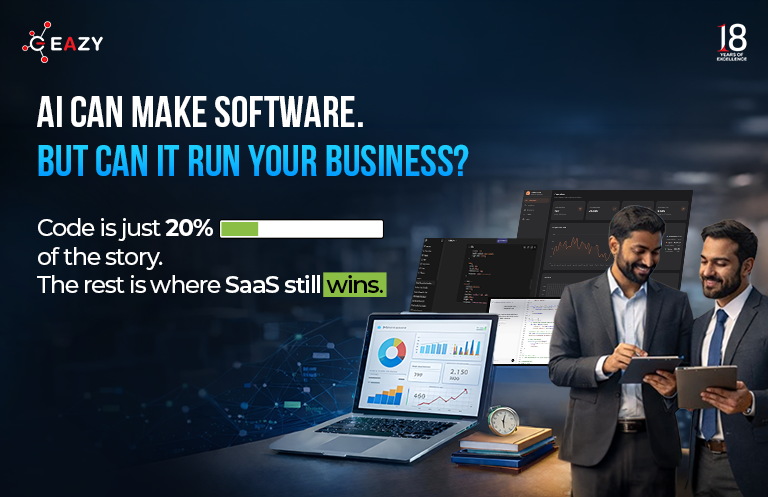
AI Can Write Code. But Can It Run Your Business?
A few months ago, a founder asked me something very directly: “We’re exploring AI tools to build internal systems. Do we still need a software partner?” It wasn’t casual, it was a serious question and honestly, it’s a fair question. AI can generate code, build dashboards, even create working applications in hours. So naturally, it feels like: Why depend on software companies at all? But if you step back and look at how businesses actually operate, the answer becomes clearer.
Industry studies suggest that over 60–70% of enterprise software initiatives fail to meet expectations, not because of poor technology, but due to gaps in adoption, integration, and execution. And that’s where most AI conversations fall short, let us see the five reasons that consistently show up across real implementations:
Reason 1. Software is easy to build but hard to run.
AI can generate applications quickly but running them across departments, users, and real workflows is where complexity begins. Most failures don’t happen at build stage, they happen during execution.
Reason 2. Business processes are never standard.
Every company has its own way of operating: approvals, exceptions, dependencies. AI can create generic logic, but aligning it to real-world processes requires deep business understanding.
Reason 3. Adoption breaks most systems.
Even the best system fails if teams don’t use it properly. Training, onboarding, and change management are critical and these are not solved by code.
Reason 4. Systems must continuously evolve.
Businesses don’t stay static as new products, new markets, and new workflows come. A system built once is rarely enough, it needs to evolve constantly and that requires structured ownership.
Reason 5. Accountability cannot be automated.
When something breaks, someone needs to fix it. Thereby, when requirements change, someone needs to align them. SaaS companies bring long-term accountability, something AI tools don’t provide.
The Real Lesson Businesses Often Miss
Most businesses don’t struggle with building software, they struggle with making it work because software doesn’t sit in isolation, it sits inside messy operations, across teams, dependencies, and constant changes. What looks perfect in a prototype, starts behaving very differently in real life.ltes assume they should.
This is something most people underestimate. Writing code is only a small part of the effort, the rest lies in understanding workflows, handling edge cases, driving adoption, maintaining data quality, and adapting continuously. That’s where complexity begins and that’s the part AI conversations usually skip. Yes, AI has dramatically improved development speed, what used to take months can now be done in days but faster builds don’t automatically translate into better outcomes. Because value doesn’t come from how fast something is created, it comes from whether it actually works, consistently, across the business.
What we’re seeing across companies
There’s a pattern emerging: some companies are still stuck with legacy systems, slow, rigid, hard to evolve and others are going all-in on AI-built tools. Initially, it feels great, quick setup, lower cost, and fast output but a few months later, reality kicks in. The system works but only for a part of the business, beyond that, things start slipping. Teams create workarounds, some processes move outside the system, manual coordination comes back, and slowly, the system becomes something people work around, not through.
What happens after go-live is what actually matters
This is the most ignored part because the real work starts after implementation. People need to use the system, data needs to stay accurate, changes keep coming in, and if every small fix depends on internal effort, the system starts becoming a bottleneck. And over time, what looked like a cost-saving decision turns into an operational headache.
So, will AI replace SaaS companies? Wrong question, the real question is: Can AI take responsibility for making systems work in real business environments? Not just build them but run them, support them, and evolve them but right now, it can’t.
A Final Thought from 18+ Years of ERP Experience
AI will make software better with faster development, better features, and smarter systems but it won’t remove the need for: implementation, support, domain expertise, and long-term ownership. AI is not replacing SaaS companies, it’s separating them from those who only build software and those who actually understand how businesses run. And going forward, that’s the only difference that will matter.
If you’re evaluating how AI and enterprise systems fit into your business, it’s worth understanding what goes beyond just building software.
Explore how modern systems are designed to actually run operations → with us.
We provide a holistic unified ecosystem from ERP, DMS, SFA, to retail platforms, so that your business doesn’t feel broken.
FAQs
AI can assist in building applications faster, but it cannot replace SaaS companies that provide implementation, integration, support, and long-term system ownership.
Because businesses need systems that work reliably across teams, processes, and scale, not just software that is built quickly.
AI-built tools focus on creating applications quickly, while SaaS platforms provide structured, scalable systems with ongoing support, updates, and operational alignment.
References:
https://www.callibrity.com/articles/why-software-projects-miss-the-mark#:~
https://www.linkedin.com/pulse/why-70-enterprise-ai-projects-fail-before-scale-what-cxos-can-hcaof/
